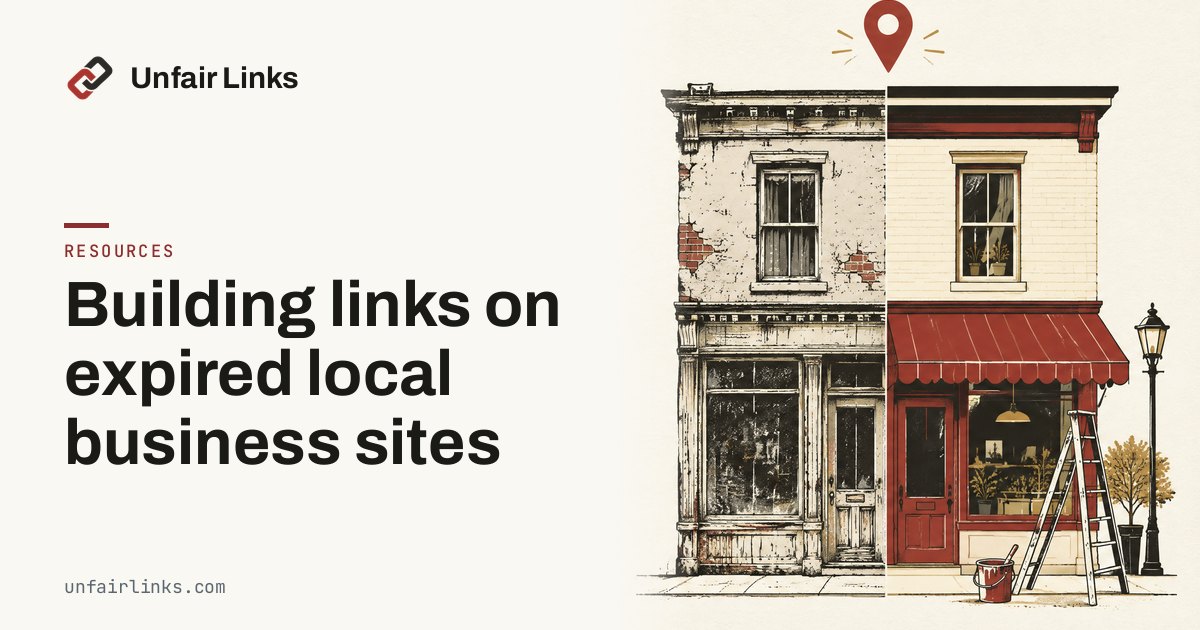
Building links on expired local business sites means placing links on rebuilt websites of real businesses whose domains lapsed. The domain expired, but the business’s Google Business Profile, reviews and social pages often did not. Rebuilding the site puts a working website back where all of those still point.
It is a different idea from the classic expired-domain network. It also carries real risk, and Google has a spam policy that covers expired domains, so we explain both below.
What survives when a domain lapses
A domain and a Business Profile are separate things. When an owner stops renewing the domain, the profile, reviews and social accounts are often left as they were. Many still name the business and link to the old address.
Google also keeps closed businesses visible. Its help page on closing a location says a closed profile “may still appear on Search and Maps for users who search for it”. It is clearly marked as closed. Whether a business is closed or still trading matters, and we cover the difference in closed vs active businesses.
So a lapsed domain can still sit behind:
- A verified Business Profile with a name, category and address.
- A KGMID, the ID Google uses for the business as an entity.
- Years of Google reviews and a star rating.
- Social profiles on Facebook, Instagram and similar sites that link to the domain.
None of these come with the domain. Our domain data comes from ExpiredLocal, a database of expired business domains. It says it plainly: “Google Business Profiles and social accounts have separate owners and are not included.” A rebuilt site doesn’t control them. It is simply the website they point at.
Why rebuilding brings those signals back
Google’s ranking systems guide describes systems that study “how pages link to each other as a way to determine what pages are about”. A profile, its reviews and the business’s social pages all reference the same domain. While the domain is dead, those references lead nowhere.
Once a site is live again, there is a real website at the end of them. That website belongs to a business Google already recognises. We explain how Google makes that connection in how Google connects websites to entities and the Google Business Profile link signal.
Google already joins links, reviews and businesses together for local search. Its local ranking help says prominence is “based on info like how many websites link to your business and how many reviews you have.”
How this differs from a generic expired-domain PBN
A typical private blog network (PBN) buys expired domains for their backlink metrics. What the old site was about rarely matters. The new content is often on a different subject entirely.
An expired local business site is chosen the other way round:
- Entity first, metrics second. The question is whether a real, verified business stands behind the domain, not how high its DR is.
- Same subject. A plumber’s site is rebuilt as a plumbing business, in its own country and language.
- Something you can check. A generic PBN gives you a DR score. A business site gives you a Maps listing, a KGMID and reviews you can look up yourself.
The trade-off is that these sites are rarely metric-heavy. Their DR is usually modest, because Ahrefs measures backlinks, not entities. We explain why in why DR can’t measure entity strength, and compare link types in entity links vs PBNs, guest posts and niche edits.
What Google’s expired domain abuse policy says
Google’s spam policies define expired domain abuse in one sentence. It is “where an expired domain name is purchased and repurposed primarily to manipulate search rankings by hosting content that provides little to no value to users.” Google gives three examples:
- Affiliate content on a site previously used by a government agency.
- Commercial medical products sold on a site previously used by a non-profit medical charity.
- Casino content on a former elementary school site.
Google announced the policy in its March 2024 search update. It said expired domains were being bought “with the primary intention of boosting search ranking” of low-quality or unoriginal content. It added: “This can mislead users into thinking the new content is part of the older site.”
How our approach relates to the policy
Every one of Google’s examples is a jump in topic. Rebuilding a business’s site in its own category and language avoids that kind of mismatch. It is why we never reuse a site across niches, and why each domain is spam-checked before it is rebuilt.
That does not put these sites outside the policy. The policy is about purpose and value, not only topic. A site rebuilt partly to carry links can still be judged as repurposed to manipulate rankings.
Paid links carry their own risk too. Google’s link spam policy lists “buying or selling links for ranking purposes”. It warns that sites that break its policies “may rank lower in results or not appear in results at all.” No link bought for ranking is risk-free, including ours. We go through the questions buyers ask in are expired business links safe for tier 1?
Where Unfair Links fits
Every Unfair Links placement sits on a rebuilt site like this, matched to your page’s topic, country and language. Each delivered page shows the business behind it: name, category, location, KGMID, Google Maps link, reviews, Entity Health score and social profiles. You can check every one yourself.
The first page on a site is $30, and each extra page on the same site is $15. Create a free account to see which sites match your page before you pay.
Related
- How Unfair Links works
- What to expect after delivery
- How to find expired businesses with a Google Business Profile
- Why local relevance beats link metrics
- What is a healthy entity?