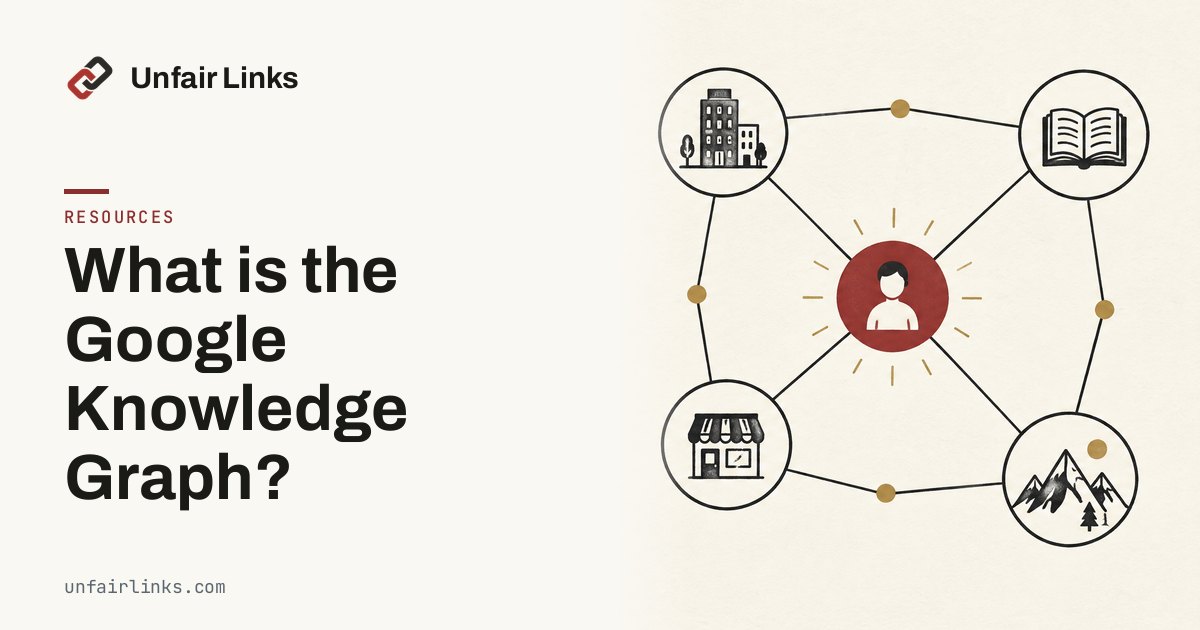
The Google Knowledge Graph is Google’s database of facts about real-world entities and how they connect. Google describes it as “our database of billions of facts about people, places, and things”. It is what lets Google answer “who”, “where” and “what” questions directly, and it is what knowledge panels are built from.
Things, not strings
Google launched the Knowledge Graph in May 2012. At launch it held more than 500 million objects and more than 3.5 billion facts about them and the relationships between them.
The launch post put the idea in three words: “things, not strings”. Before the Knowledge Graph, search mostly matched the words you typed against the words on pages. With it, Google tries to work out which real thing you mean, whether that is a person, a city, a film or a local business, and to return facts about that thing.
Where its facts come from
At launch, Google said the graph drew on public sources such as Freebase, Wikipedia and the CIA World Factbook. Today Google’s help page says facts “come from a variety of sources that compile factual information”, plus:
- Licensed data for things like sports scores and weather.
- Content owners who claim their knowledge panel and suggest changes.
- Business Profiles. Google says businesses have their own Business Profile panels, managed through Google Business Profile.
That last point matters for local SEO. A verified Google Business Profile is one of the ways a local business becomes a recognised entity.
Entities, IDs and relationships
Every entity in the graph has an ID, the KGMID. Facts and relationships attach to that ID. A restaurant’s entity, for example, can be connected to its address, its category, its reviews, its owner and the town it is in.
Because everything hangs off IDs rather than names, Google can tell apart two businesses with the same name in different towns, or a business and a common word.
Knowledge panels
A knowledge panel is the box of facts that appears beside or above search results. Google’s help page says panels “are created automatically” when there is enough information about an entity on the open web, and that a panel can stop appearing as Google’s systems change.
If you represent an entity you can claim its panel and suggest changes. Businesses manage theirs through Google Business Profile.
One graph, or several?
Google talks about “the Knowledge Graph” as one thing, but several vertical graphs feed it, including Maps, Business Profiles, Books and Scholar. We look at what that means for local businesses in Knowledge Graph verticals.
Why it matters for links
The Knowledge Graph is how Google decides that something is real. A link from a site tied to a recognised entity, with a KGMID, a verified Business Profile and a review history, comes from something Google already trusts exists.
Link metrics like Domain Rating can’t see any of that. That gap is why Unfair Links builds every placement on a real business with a real entity behind it, and shows you the proof on each delivered page.